The Shift in AI Engineering: From Prompts to Graph Orchestration
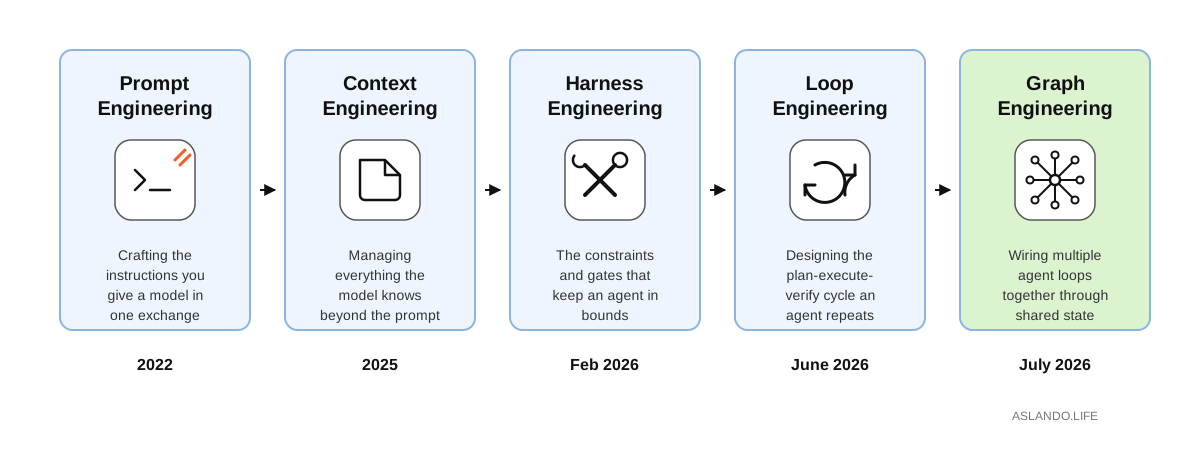
The paradigm of AI engineering has rapidly matured over a short timeline, moving from basic text manipulation to complex systems engineering:
- Prompt Engineering (2022): Crafting isolated, single-exchange instructions for a model.
- Context Engineering (2025): Managing state, memory, and structural inputs beyond the initial prompt window.
- Harness Engineering (Feb 2026): Establishing strict execution constraints and guardrails to keep agentic behaviors bounded.
- Loop Engineering (June 2026): Designing autonomous plan-execute-verify iteration cycles.
- Graph Engineering (July 2026): Interconnecting multiple agent loops via a shared, synchronized state.
The Engineering Takeaway
We have officially moved past the era of treating LLMs as standalone conversational interfaces. AI engineering is no longer about crafting clever phrasing; it is purely about architectural orchestration.
Single-loop agents inevitably hit execution plateaus. Scaling agentic capabilities demands explicit state machines, controlled boundary enforcement (Harnessing), and structured topology (Graphing).
If you are still optimizing raw prompts in isolation, you are optimizing legacy code. True technical leverage today sits at the orchestration layer—wiring specialized multi-agent loops into deterministic, state-driven execution graphs.